The narrative around India-Russia trade has shifted dramatically. What started as an energy-driven partnership has evolved into a strategic commercial alliance. In December 2025, both nations reaffirmed their commitment to a massive goal: $100 billion in bilateral trade by 2030.
For Indian businesses, this isn’t just a political headline—it is a clear market signal. With bilateral trade already crossing $68 billion in 2024-25, the foundation is set. However, a massive imbalance remains: India imports over $60 billion (mostly oil) but exports only around $5 billion.
To fix this, the Indian government has identified 300 specific products that Russia needs immediately to replace Western suppliers. If you are a manufacturer in India, 2026 is your golden window to enter this market before the competition catches up.
1. What to Sell? The “300 Products” Opportunity
The “Western Vacuum” left by departing US and European brands has created a hunger for Indian goods. The government’s identified list of 300 products focuses on sectors where India has global dominance but low market share in Russia.
- Engineering & Machinery: This is the largest gap. Russia imports $37 billion of engineering goods globally, but India currently supplies only $1.7 billion. Demand is high for industrial machinery, auto components, and tools.
- Pharmaceuticals: Russia imports nearly $10 billion in pharma annually. India, the “Pharmacy of the World,” supplies only ~$546 million. The opportunity here is for Generics and APIs (Active Pharmaceutical Ingredients) to secure Russia’s healthcare supply chain.
- Agriculture & Food: From tea and coffee to processed foods, Indian agri-exports are set to surge. Russia’s global import demand is $3.9 billion, yet India currently captures just $452 million of this.
- Electronics: Currently, Indian electronics have less than 1% market share in Russia. With the right distribution, this is a high-growth sector.
2. Logistics Revolution: Moving Goods Faster in 2026
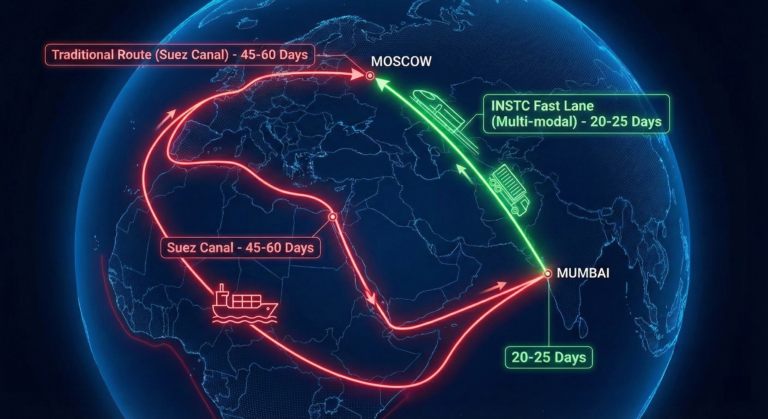
The days of 40-day shipping times via the Suez Canal are ending. Two major corridors have become operational game-changers in 2025-2026.
The INSTC (International North-South Transport Corridor)
This multimodal route (Ship + Rail) connects Mumbai to St. Petersburg via Iran and the Caspian Sea.
- Speed: Transit times have dropped to 16-25 days (down from 40+ days).
- Cost: Logistics costs have decreased by 30-50% over the last two years.
- Volume: Cargo traffic on this route jumped 19% in 2024, proving it is commercially mature.
The Chennai-Vladivostok Maritime Corridor (CVMC)
Officially operational as of late 2024, this Eastern corridor connects Chennai directly to Vladivostok in Russia’s Far East.
- Transit Time: 24 days.
- Strategic Advantage: It completely bypasses European waters and the Suez Canal, making it immune to Western geopolitical disruptions.
3. Getting Paid: The Rupee-Ruble Settlement
The biggest myth in 2026 is that “payments are stuck.” The banking infrastructure has matured significantly.
- Speed: Sberbank’s Indian branch reported in 2025 that payment processing from Russia to India has accelerated to just a few minutes.
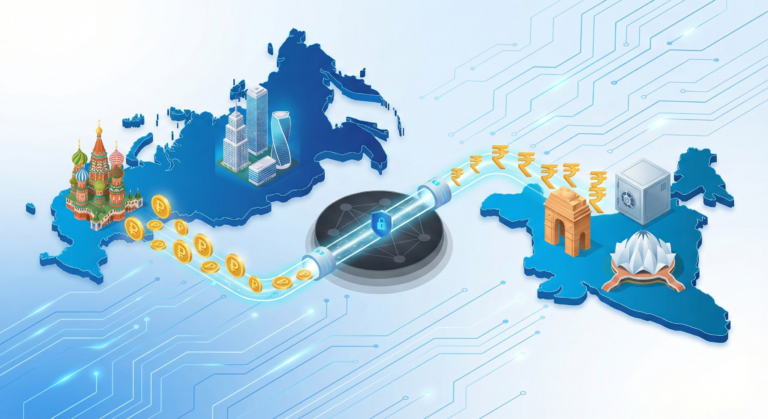
- Security: Most transactions are now settled in national currencies (Rupee and Ruble), bypassing the US Dollar and SWIFT completely.
- Risk Mitigation: New financial tools like Letter of Credit (LC) discounting are now available to Indian exporters, allowing you to get paid upfront while the bank manages the settlement risk.
Conclusion: The First-Mover Advantage
The target is set, the logistics routes are open, and the payment channels are fast. The only missing piece is you.
Russian buyers are actively seeking reliable Indian partners to fill the gaps in their supply chains. By 2030, this trade corridor will be crowded. The businesses that establish their relationships in 2026 will be the ones leading the $100 billion charge.
Ready to start? At Altai Global, we don’t just give advice; we handle the execution. From finding buyers for your specific product to managing INSTC logistics and Rupee payments, we are your bridge to Russia.