Avoid the traps that kill export deals. From signing DDP contracts without a local entity to the “English Label” mistake, here are the top 5 errors Indian exporters make in Russia.
The “Tuition Fee” You Don’t Want to Pay
Russia is a high-reward market, but it is also a high-compliance market. Unlike exporting to Dubai or the UK, where rules can be flexible, Russian customs (FTS) and banking systems are rigid.
We have seen shipments worth ₹50 Lakhs get stuck at the port simply because a sticker was in the wrong place. We have seen payments frozen for weeks because an invoice used the wrong currency code.
Here are the 5 most expensive mistakes Indian exporters are making in 2026—and how you can avoid them.
Mistake #1: Signing “DDP” Contracts Without a Local Entity
This is the single biggest deal-killer. Many Indian exporters, eager to please the buyer, agree to DDP (Delivered Duty Paid) terms. This means you are responsible for clearing customs and paying import duties in Russia.
The Problem: Under Russian law, a foreign company cannot clear goods or pay duties unless they have a registered legal entity in Russia. If you sign DDP and ship the goods, they will sit at the port because you legally cannot pay the tax to release them.
- The Fix: Always sign CIF (Cost, Insurance, and Freight) or DAP (Delivered at Place) contracts. Let the Russian buyer handle the import clearance. If they insist on DDP, you must hire an Importer of Record (like Altai Global) to handle the clearance for you.
Mistake #2: The “English Label” Trap
You might think English is the universal language of trade. In Russia, it is not. Strict consumer protection laws require that all retail products have a label in the Russian language containing:
- Product Name & Ingredients/Composition
- Manufacturer’s Address
- Expiry Date & Storage Conditions
- The EAC Mark
The Problem: If your goods arrive with only English labels, customs will not release them. You will have to pay a bonded warehouse to re-label every single unit by hand. This costs a fortune.
- The Fix: Send your label design to us before you print. We will translate it, ensure the mandatory details are present, and give you the “Green Light” to print.
Mistake #3: Still Using “Third-Party” Payment Routes
Some exporters try to be “clever” by routing payments through a shell company in Dubai or Singapore to avoid direct India-Russia trade.
The Problem: This triggers AML (Anti-Money Laundering) flags. Intermediary banks (often using US/EU correspondence) will block the funds if they suspect the origin is Russia. You end up with money stuck in limbo for months.
- The Fix: Stop hiding. The Rupee-Ruble mechanism is legal, sanctioned-proof, and direct. Use a Vostro account and invoice directly from India to Russia. It is the cleanest way to operate in 2026.
Mistake #4: Mismatched HS Codes
In India, your product might fall under one HS Code. In Russia, it might fall under a slightly different one due to interpretation.
The Problem: If the HS Code on your invoice doesn’t match the HS Code the Russian buyer uses for their declaration, customs will flag the discrepancy as “Duty Evasion.” This leads to heavy fines (up to 200% of the duty value).
- The Fix: Confirm the Russian HS Code (TN VED) with your buyer before you generate the Commercial Invoice. Do not assume the Indian code works automatically.
Mistake #5: Treating Russia as “One Market”
Russia is the largest country in the world. Shipping to St. Petersburg (West) is totally different from shipping to Vladivostok (East).
The Problem: We see exporters quoting a “delivery price to Russia” without realizing that trucking goods from St. Petersburg to a buyer in Novosibirsk (Siberia) costs as much as the sea freight from Mumbai!
- The Fix: Always ask for the final delivery city.
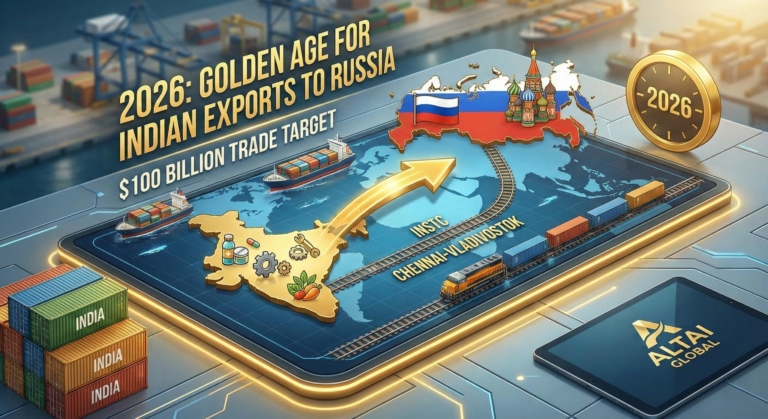
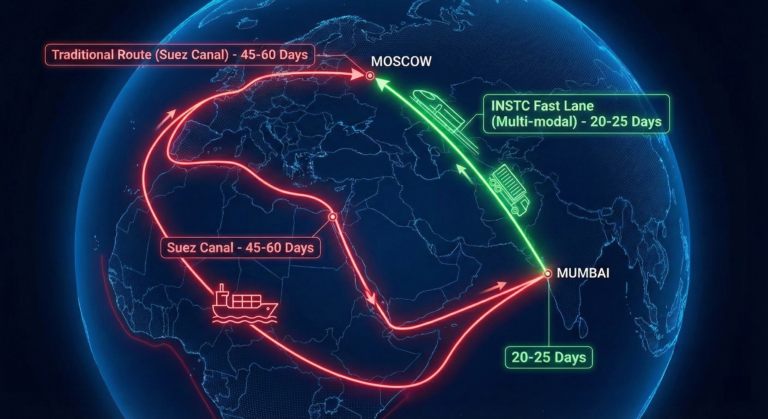
- For Moscow/St. Petersburg: Use the INSTC route (via Iran/Caspian).
- For Siberia/Far East: Use the Chennai-Vladivostok maritime route.
Conclusion: Details Matter
The difference between a profitable deal and a loss is often just one clause in a contract or one sticker on a box.
Don’t guess. At Altai Global, we review your Sales Contract, Invoice, and Labels before you ship. We act as your safety net to ensure your first shipment is a success, not a lesson.
[Book a Pre-Shipment Document Review]